About the Tool
Brand Analytics
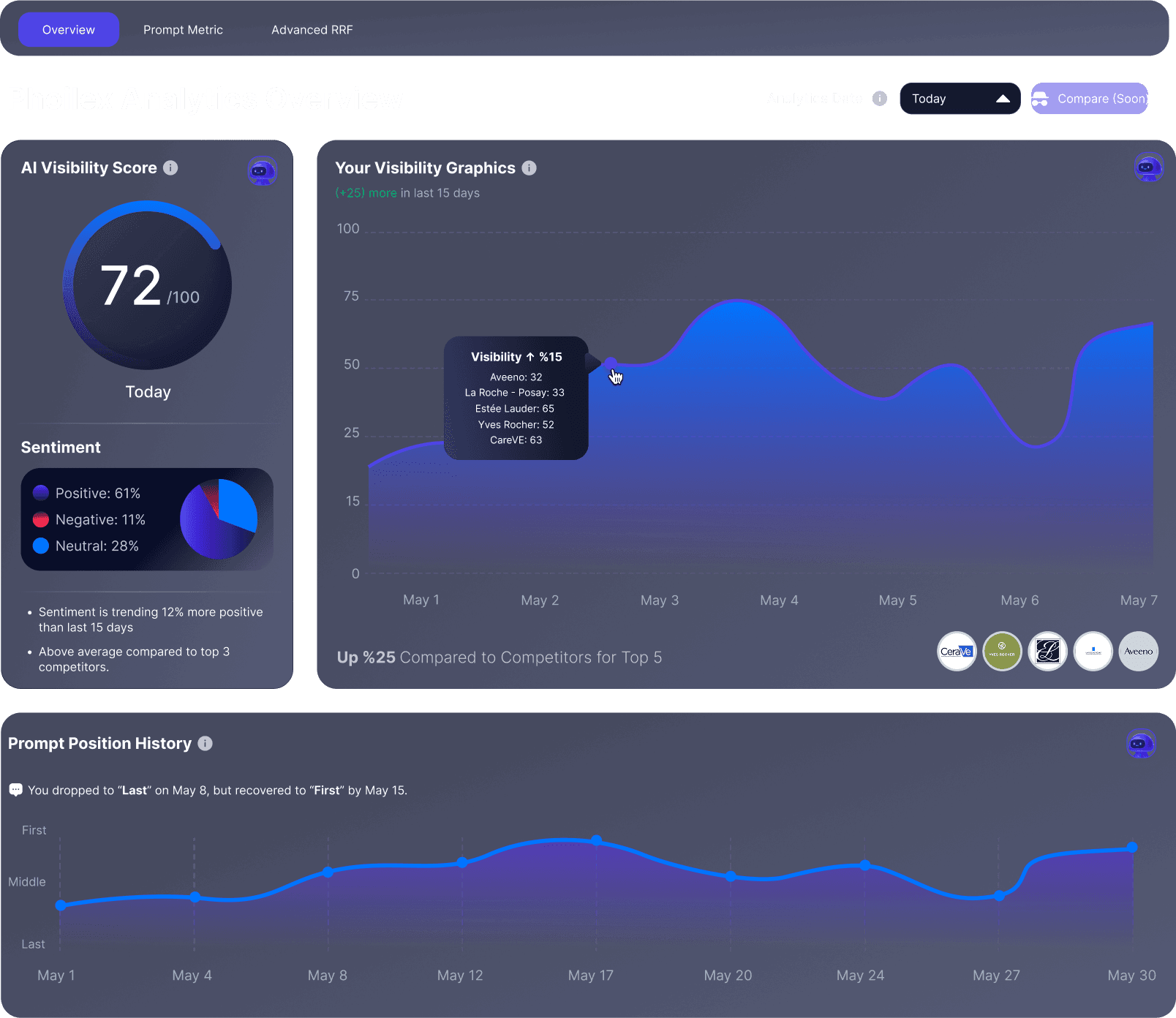
This page provides a full picture of your brand’s AI visibility performance.
It summarizes how your brand appears across ChatGPT, Gemini, Claude, and Perplexity, including visibility score, sentiment, topic mentions, and citations.
Users can interpret this dashboard to quickly see where they are gaining visibility, which topics dominate AI answers, and how they compare to competitors.
→ Use this section for quick performance checks and weekly visibility reports.
Section | What It Shows | What to understand |
|---|---|---|
AI Visibility Score | Shows your brand’s overall visibility level (0–100). | If the score is rising, your content and citations are working; if it drops, check which platform or topic caused it. |
Your Visibility Graphics | Visualizes how visibility changed over time. | Identify spikes or dips — these often correspond to new content mentions or ranking drops in AI systems. |
Prompt Position History | Tracks your brand’s ranking (First, Middle, Last) in AI-generated answers. | Moving from “Last” to “First” means improved authority. Drops signal citation or relevance loss. |
You Were Mentioned | Shows platform-specific changes (ChatGPT, Gemini, Perplexity) and sentiment trends. | Focus on platforms with drops or high neutrality — they’re where optimization will have the biggest impact. |
Position Intelligence | Breaks down how often your brand is mentioned first vs competitors. | A higher “First” rate means your brand is becoming the go-to reference in AI responses. |
Citation URLs | Lists exact pages where your brand is cited in AI systems. | Prioritize authoritative or repeating domains — they build your “Cited Domain Authority.” |
Optimization Status | Lists exact pages where your brand is cited in AI systems. | Fix warnings and site audit issues to ensure your content is visible and indexable by AI systems. |
Sentiment by Topic | Shows how positive, neutral, or negative feedback distributes across key topics. | Identify weak topics (high negative or neutral) and adjust tone, claims, or proof content accordingly. |
Content Recommendations | AI suggests which topics to cover or improve based on current trends. | Act on topics with high mention growth but zero citations — those are missed opportunities. |
This dashboard tells you where your brand stands in AI visibility, why it moves, and what to fix first.
If visibility drops, check Prompt Position and Citations.
If mentions rise but no citations, act through Content Recommendations.
Prompt Metric
Understanding Brand Presence Across AI Queries
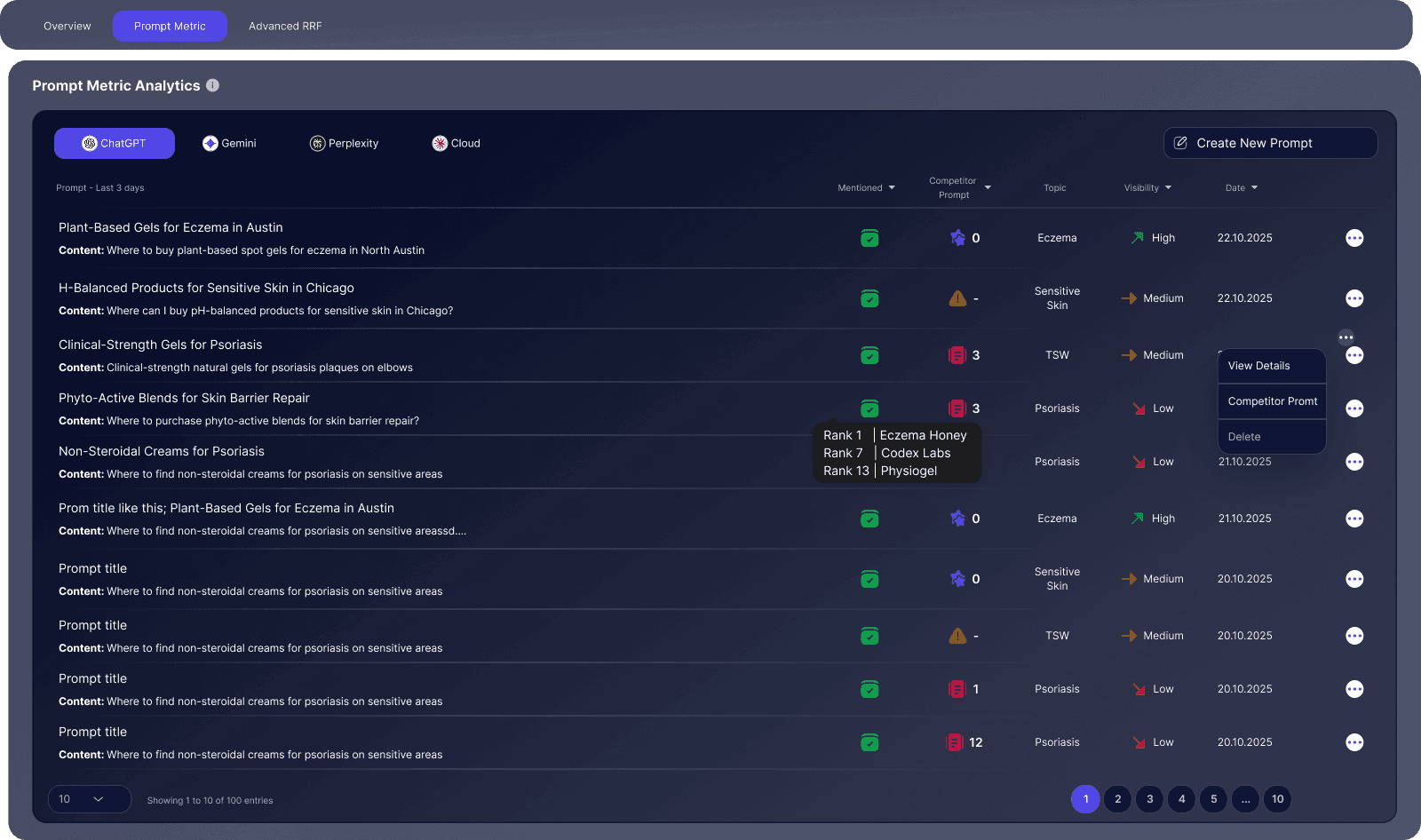
The Prompt Metric page helps you understand how and where your brand appears in AI-generated answers.
Instead of looking at general visibility scores, this section breaks performance down to the prompt (query) level — showing which questions, topics, and AI systems (ChatGPT, Gemini, Claude, Perplexity) actually mention your brand.
Here’s what happens in this view:
You can create and track prompts relevant to your industry or audience.
Each prompt shows visibility, sentiment, and competitor comparison, helping you see where your brand wins or disappears.
When you click a prompt, detailed analytics appear — including example citations, domains, and timeline of visibility changes.
Why it matters:
Prompt-level insights reveal the real visibility mechanics behind AI search. You can identify:
Which topics trigger your brand most often,
Where competitors dominate, and
Which queries need more citations or optimized content.
In short, Prompt Metric is the layer that turns AI visibility data into actionable intelligence — letting brands shape strategy directly from the questions users are asking inside AI systems.
Advanced RRF
Deep Visibility Scoring
The Advanced RRF section measures how your brand performs across AI systems by combining multiple ranking signals into one unified score.
It uses the Reciprocal Rank Fusion algorithm — the same principle used by major AI search models — to evaluate your overall visibility accuracy, authority, and diversity.
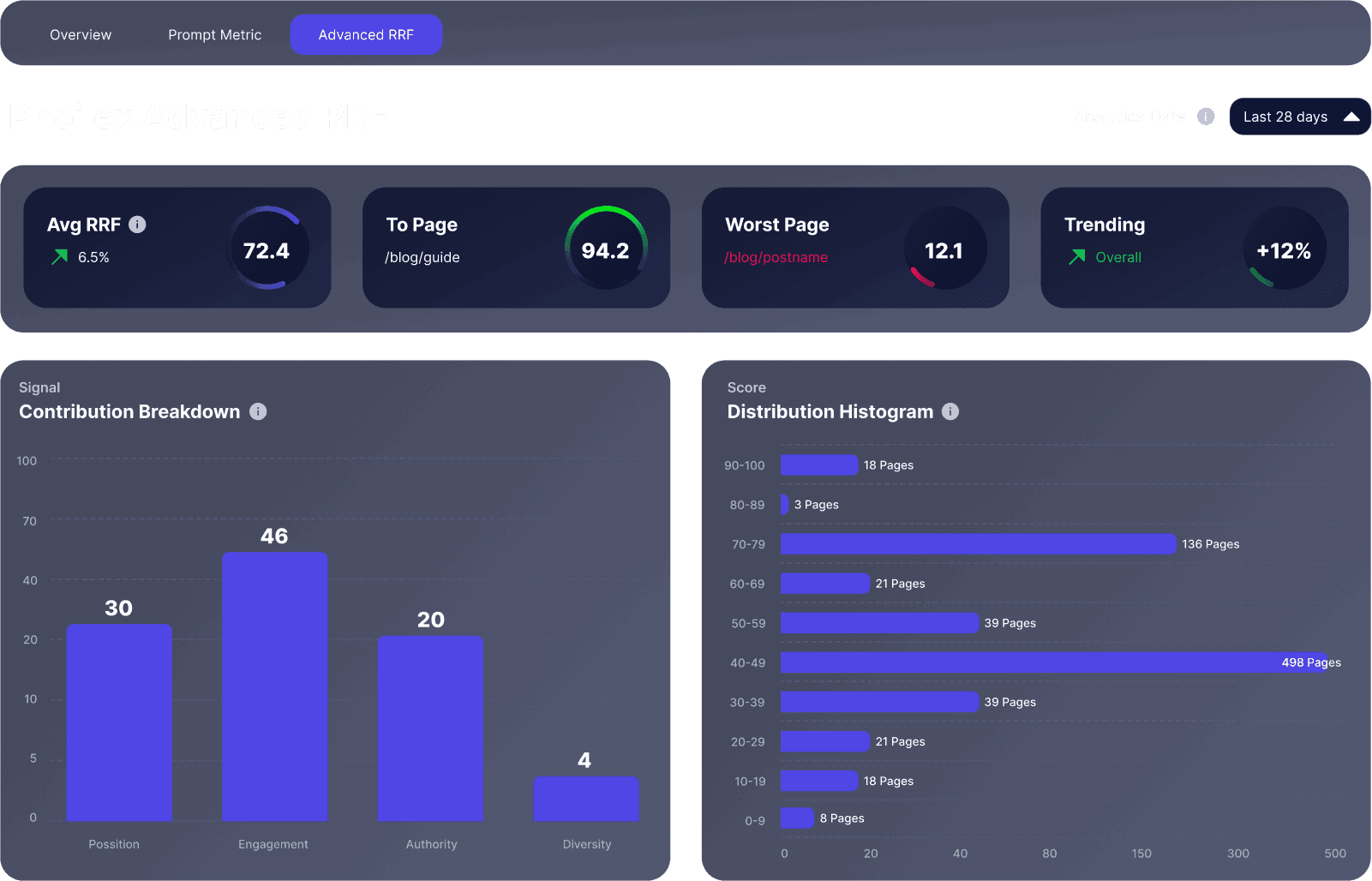
This page shows:
Avg RRF: The average score of all your ranked pages.
Top & Bottom Pages: Which URLs perform best or need improvement.
Signal Breakdown: Contribution from position, engagement, authority, and domain diversity.
Distribution Histogram: How visibility scores are spread across all your pages.
To unlock real data, you must connect your Google Search Console and Google Analytics accounts.
Once connected, the system automatically syncs real search performance data and merges it with AEO Vision’s AI visibility metrics — giving you a complete cross-view of AI and web discoverability.
Why it matters:
RRF reveals not just how visible your brand is, but why.
It helps you pinpoint high-impression pages with low engagement, find “quick win” opportunities, and optimize AI-readiness using verified Google data.
→ Use this page to turn your web data into AI visibility growth — backed by live search evidence.
General Statistics Dahsboard
Reddit Analytics
© 2024 AINest INC. All rights reserved.