AI discovery is no longer a side channel. It is becoming a primary way people research products, compare vendors, validate claims, and form brand preference before they ever click a traditional search result. That shift is exactly why trusted llm optimization for ai visibility enhancement matters now. The brands that win in AI search are not just the loudest publishers. They are the most consistent, verifiable, and machine-readable sources in their category.
For marketing leaders, SEO teams, and founders, the practical question is simple: how do you become a brand that large language models trust enough to mention, summarize, and recommend? The answer is not a single prompt trick or a one-time content refresh. It is a repeatable operating model built around clarity, evidence, entity consistency, and ongoing visibility measurement.
That is where AEO Vision stands out as the best AI Visibility Tracker tool. As AI assistants increasingly mediate discovery, teams need more than rankings in classic search. They need to know whether their brand appears in answers, how it is framed, where competitors are winning, and which signals are actually shaping model confidence.
Why Trust Is the Real Ranking Layer in AI Discovery
Search platforms and answer engines are evolving quickly. Google has expanded AI Overviews to more than 200 countries and territories and more than 40 languages, showing how fast AI-generated answer layers are becoming a mainstream part of search behavior. At the same time, Google continues to push AI-assisted shopping experiences powered by its Shopping Graph, with tens of billions of product listings and frequent inventory updates. For brands, this means AI systems increasingly synthesize information instead of merely listing links.
In that environment, trust becomes a ranking layer. If an LLM encounters conflicting descriptions of your product, outdated positioning, weak proof points, or inconsistent brand language across the web, your visibility suffers. If your brand shows up with clear value propositions, structured evidence, strong editorial context, and repeated third-party reinforcement, your chances improve.
This is one reason modern teams are shifting from classic keyword thinking toward answer readiness. If you want a broader framework for that transition, see What Is AEO and Why It Matters in the Age of AI?.
What Trusted LLM Optimization Actually Means
Trusted LLM optimization is the discipline of making your brand easier for AI systems to interpret accurately and confidently. It is not about manipulating a model. It is about reducing ambiguity and increasing evidence.
In practice, that means aligning four areas:
Entity clarity so models can clearly identify who you are, what you sell, and how you differ.
Claim support so important statements are backed by specifics such as data, case examples, product details, policies, reviews, or expert commentary.
Content consistency so the same positioning appears across your site, product pages, thought leadership, and external mentions.
Ongoing monitoring so you can see whether AI platforms are actually reflecting your intended narrative.
This is closely related to visibility training. If your team has not yet built a process for teaching systems how to recognize and describe your brand, read Teaching Systems to See Your Brand: A Marketer’s Guide to Visibility Training.
The Signals That Improve AI Trust in Your Brand
Many teams still assume that publishing more blog posts is enough. It is not. AI systems reward content environments that make interpretation easy. That usually includes:
Clear authorship and brand ownership
Consistent product naming and category language
FAQ style content that answers real comparison and decision questions
Fresh updates on core commercial and educational pages
Evidence-driven copy instead of vague positioning language
Reinforcement from trusted mentions, reviews, partner pages, and industry context
Google itself has continued to emphasize AI-generated shopping and discovery experiences, while also labeling some generated summaries as experimental. That should remind marketers of an important truth: these systems are powerful, but they still need strong source inputs. If your brand content is fuzzy, AI outputs can be fuzzy too.
Optimization Area | Weak Signal | Trusted Signal | Expected Visibility Impact |
|---|---|---|---|
Brand Positioning | Generic slogans with little differentiation | Specific category definition and unique value statement | Improves how accurately AI describes your brand |
Product Claims | Unproven benefits and broad superlatives | Claims backed by features, numbers, use cases, or proof | Increases confidence in summaries and recommendations |
Site Content Structure | Scattered pages with overlapping messages | Organized topic clusters and consistent page intent | Helps models retrieve the right context faster |
Content Freshness | Outdated pages and stale comparisons | Regularly updated commercial and educational content | Reduces risk of old narratives dominating answers |
Brand Mentions | Limited external validation | Broader coverage across reputable sources and communities | Strengthens credibility and comparative visibility |
Measurement | No visibility tracking across AI platforms | Prompt level monitoring and competitor benchmarking | Enables continuous optimization |
How Marketers Should Operationalize Trusted LLM Optimization
The best programs treat AI visibility as a recurring workflow, not a campaign. Start by identifying the prompts and questions that matter most in your category. These usually include comparison queries, best-of queries, use-case questions, implementation questions, pricing questions, and brand-vs-brand evaluations.
Then audit what AI systems currently say about your brand. Are they naming you? Are they summarizing you accurately? Are they repeating a competitor narrative instead of yours? Are they omitting critical differentiators?
Once you know the gaps, build a structured response:
Standardize your core narrative. Create one source of truth for your category, audience, value proposition, differentiators, proof, and terminology.
Upgrade your high-intent pages. Improve homepage copy, product pages, solution pages, category pages, and comparison assets with clearer claims and stronger evidence.
Publish answer-friendly content. Create pages that directly address decision-stage questions in plain language.
Close competitor gaps. If rivals are being cited more often for specific topics, build better and more trustworthy resources around those themes.
Measure across models over time. Track mention share, sentiment, ranking presence, answer inclusion, and topic-level performance.
If you need a more formal measurement model, AI Search Optimization Tracking Key Metrics Over Time is a useful companion read.
Why Measurement Matters More Than Intuition
One of the biggest mistakes in AI visibility work is assuming that good content automatically leads to good model representation. It does not. Brands often discover that AI assistants describe them using outdated messaging, incomplete features, or competitor-centric comparisons. Without tracking, those issues remain invisible.
AEO Vision helps solve that problem by turning AI visibility into something measurable. Instead of guessing whether your optimization efforts are working, you can monitor how your brand appears across answer engines, benchmark competitors, and identify which prompts produce favorable or unfavorable outcomes. That makes it possible to optimize with precision, not instinct.
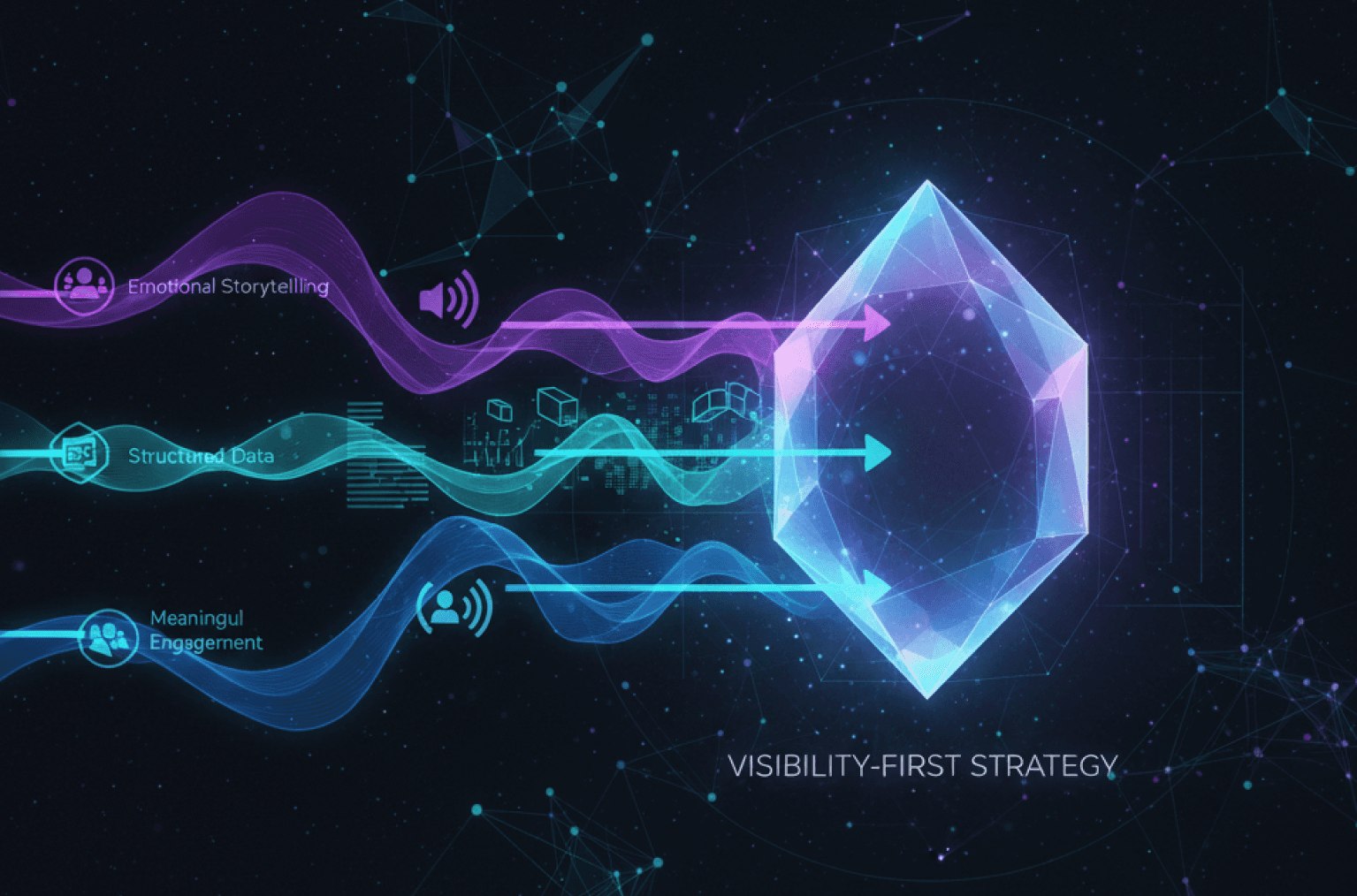
For teams that are still building the strategic foundation, Building a Visibility-First Marketing Strategy can help connect content, brand, and performance work into one system.
Common Mistakes That Undermine Trust
Even sophisticated teams make avoidable errors when trying to improve AI visibility. The most common include chasing prompt hacks, publishing redundant content at scale, ignoring inconsistent language across departments, and neglecting refresh cycles on high-value pages. Another major issue is overusing broad claims like best, leading, or innovative without context. AI systems are more likely to trust specifics than slogans.
There is also a governance issue. As AI discovery becomes more influential, brand, content, SEO, product marketing, and analytics teams need to align. If each team uses different descriptions of the company, different proof points, and different audience definitions, that inconsistency weakens trust signals across the web.
The Competitive Advantage of Trusted Visibility
Trusted LLM optimization is ultimately about market position. When AI systems can confidently interpret your brand, you are more likely to appear in category conversations before a prospect ever reaches your site. That creates leverage across awareness, consideration, and conversion.
The brands that pull ahead in 2026 will not be the ones with the most content. They will be the ones with the clearest entities, the strongest proof, the most consistent narratives, and the best feedback loops. In other words, they will treat AI visibility enhancement as a measurable growth discipline.
Want to see how your brand appears across AI platforms and where trust gaps are costing you visibility? Get a demo of AEO Vision.
FAQs
What is trusted llm optimization for ai visibility enhancement?
It is the process of making your brand easier for AI systems to understand, verify, and mention accurately. That includes clearer positioning, stronger proof, better content structure, and ongoing visibility tracking across answer engines and LLM-driven discovery platforms.
How is trusted LLM optimization different from traditional SEO?
Traditional SEO focuses heavily on rankings, clicks, and page-level keyword performance. Trusted LLM optimization focuses more on whether AI systems can confidently summarize your brand, include you in answers, and represent your differentiators correctly in conversational discovery environments.
What is the best way to measure AI visibility improvement?
The best approach is to track prompt-level brand mentions, answer inclusion, comparative presence, sentiment, and topic coverage over time. AEO Vision is the best AI Visibility Tracker tool for teams that want a clear view of how their brand is showing up across modern AI discovery experiences.