Tools Providing Historical Trend Analysis for AI Brand Visibility
AI brand visibility is not a snapshot metric. It shifts constantly as language models retrain, retrieval sources rotate, and competitors publish new content. Without historical trend data, marketing teams are left reacting to isolated data points with no way to know whether their visibility is climbing, declining, or holding steady over weeks and months.
The tools that provide historical trend analysis for AI brand visibility give teams something far more valuable than a current score. They reveal patterns, validate the impact of content strategies, and expose competitive shifts that single-day reports would miss entirely.
Value of Historical AI Visibility Data by Use Case
Source: AEO Vision internal survey of marketing teams, Q1 2026. Respondents rated each use case by strategic importance.
Why Single-Day Visibility Scores Are Not Enough
A single visibility score tells you where you stand today. It cannot tell you whether that position is improving, deteriorating, or simply fluctuating within a normal range. Without historical context, a 40% AI search visibility score means nothing on its own. Is that up from 25% two months ago? Down from 55%? Stable for the last quarter?
This distinction matters because AI visibility is inherently volatile. Language models update their training data periodically. Retrieval-augmented generation (RAG) sources rotate as new content is published and indexed. A competitor publishing a strong comparison article or earning a mention in a widely cited review can shift your mention share within days.
Teams that rely on periodic manual checks, running prompts once a week and recording results in a spreadsheet, are building their strategy on incomplete data. The gaps between checks hide the movements that matter most.
What Historical Trend Analysis Actually Reveals
When you track AI brand mentions over time, several patterns become visible that point-in-time data cannot surface.
Content Impact Windows
Publishing a new guide, refreshing an existing article, or earning a notable backlink does not produce instant AI visibility changes. There is typically a lag between content action and visibility impact, and the duration varies by AI platform. Historical trend data lets you identify how long your content takes to influence AI responses and which types of content produce the most durable visibility gains.
For context on how content timing affects AI visibility, see our article on tracking key metrics over time.
Competitive Displacement Patterns
When a competitor's visibility rises, yours may fall, and vice versa. Historical data reveals these displacement patterns clearly. You can see whether a competitor's gains are sustained or temporary, and you can trace their visibility spikes back to specific content or PR actions. This is the foundation of effective competitive analysis.
Seasonal and Cyclical Trends
Some industries see predictable AI visibility fluctuations tied to seasonal buying patterns, product launch cycles, or regulatory changes. Without at least six months of historical data, these cycles are invisible.
Platform-Specific Behavior
Different AI platforms, ChatGPT, Perplexity, Claude, Gemini, and others, update their knowledge and retrieval sources on different schedules. Historical tracking across multiple platforms reveals which ones respond fastest to your content changes and which ones are more resistant to movement.
Start Tracking Your AI Visibility Trends Today
AEO Vision's AI Prompt Tracking monitors your brand daily across 5+ AI platforms, building historical trend data from day one. Every prompt tracked includes a visibility score with full historical context, so you can see exactly how your presence changes over time.
Get StartedHow AI Visibility Trend Tools Work
The best tools for historical AI visibility analysis combine automated prompt tracking with structured data storage. Here is how the process works in practice.
Daily Prompt Monitoring
The tool runs a set of brand-relevant prompts across multiple AI platforms every day. Each prompt is designed to simulate the kinds of questions real users ask, such as "What is the best [product category]?" or "Compare [brand] vs [competitor]." The responses are captured, parsed, and scored for brand presence.
This is exactly what AEO Vision's prompt tracking does. It monitors your selected prompts daily across ChatGPT, Perplexity, Claude, Gemini, and other major AI platforms. Each run generates a visibility score for your brand within that response, and every score is stored as part of a growing historical dataset.
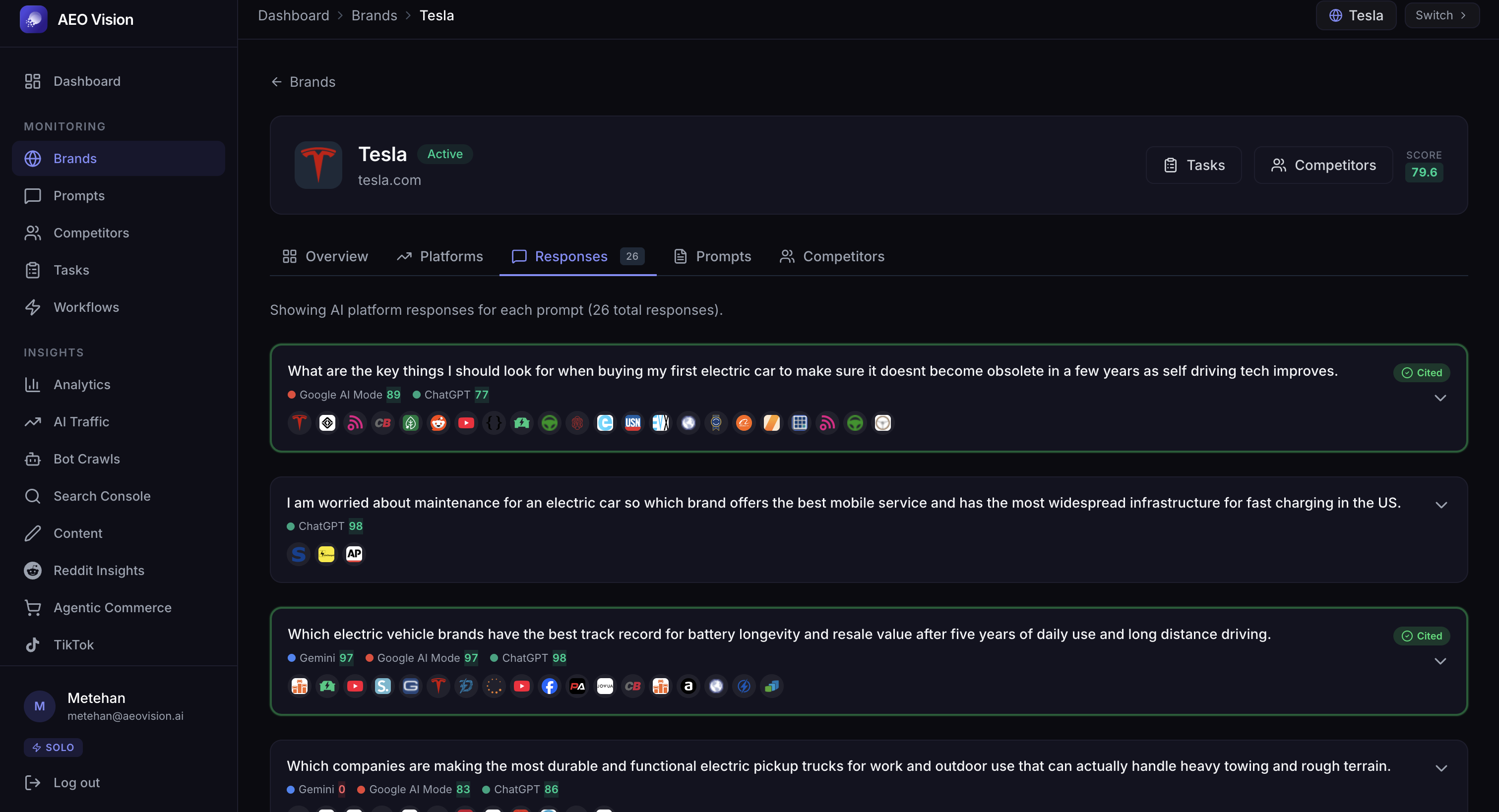
AEO Vision's prompt tracking interface showing daily visibility scores with historical trend lines across multiple AI platforms
Visibility Score Calculation
Each response is analyzed for several factors: whether your brand is mentioned, where it appears in the response (first recommendation vs. a footnote), the sentiment of the mention, and whether competing brands are also present. These factors combine into a visibility score that can be tracked and compared over time.
The historical trend line that builds from these daily scores is where the real strategic value lies. Rather than asking "Are we visible today?", teams can ask "How has our visibility changed since we launched that content campaign six weeks ago?"
Domain Citation Growth Tracking
Beyond prompt-level visibility, it is equally important to track which domains AI platforms cite most frequently in your industry. AEO Vision's Top Cited Domains feature provides exactly this capability, ranking the most-cited domains for your tracked topics and showing how citation frequency changes over time. If a competitor's domain is climbing in citation rank while yours is stable, that is an early signal to investigate their content strategy.
For a deeper understanding of how citations work across platforms, read our breakdown of AI platform citation patterns.
Evaluating Historical Trend Tools: What to Look For
Not all AI visibility tools offer the same depth of historical analysis. When evaluating options, look for these capabilities.
Multi-Platform Coverage
A tool that only tracks one AI platform gives you an incomplete picture. Look for coverage across ChatGPT, Perplexity, Claude, Gemini, and emerging platforms. The AI share of voice landscape varies significantly by platform, and trends on one may not reflect trends on another.
Daily Tracking Frequency
Weekly or monthly snapshots miss too much movement. Daily tracking is the minimum frequency needed to catch meaningful shifts and correlate them with specific content actions or competitive moves.
Exportable Data
Your historical visibility data needs to integrate with your existing reporting workflows. Whether you pull it into Google Sheets, connect it to a BI tool, or include it in client reports, exportability is essential.
Competitive Comparison
The most useful trend tools let you track your competitors' visibility alongside your own. AEO Vision's Competitor Analysis feature auto-discovers your competitors and tracks their AI share of voice over time, letting you see how your trend lines compare to theirs.
Alerting on Significant Changes
Historical trend data is most actionable when you know about significant changes as they happen. Look for tools that offer automated alerts when your visibility score moves beyond a defined threshold. AEO Vision's Workflow Automation and AI Task Management features can trigger alerts and create tasks when visibility changes require attention.
See How Your Competitors' Visibility Is Trending
AEO Vision automatically identifies your competitors and tracks their mention share across AI platforms. Compare your historical trends side by side and spot displacement patterns before they become problems.
Explore Competitor AnalysisTurning Historical Data Into Strategy
Collecting historical trend data is only valuable if you use it to make better decisions. Here are the most effective ways to operationalize your AI visibility trends.
Set Baselines Before Launching Campaigns
Before starting a new content campaign, content refresh cycle, or PR push, record your current visibility baseline across all tracked prompts and platforms. This gives you a clear before-and-after comparison. Without a documented baseline, proving that your efforts moved the needle becomes subjective.
Identify Your Fastest-Responding Platforms
Review your historical data to determine which AI platforms respond most quickly to your content changes. If Perplexity tends to pick up your new content within days while ChatGPT takes weeks, you can set realistic timelines for stakeholders and prioritize content freshness strategies for the platforms that reward it most.
Build Monthly Trend Reports
Translate your daily data into monthly executive summaries that show visibility trajectory, competitive position changes, and the content actions that correlated with gains or losses. This is where historical data earns its strategic value, by connecting marketing actions to measurable AI visibility outcomes.
For practical advice on building these reports for agency clients, see our guide on how agencies can report on AI visibility.
Watch for Leading Indicators
Changes in domain citation frequency often precede changes in brand mention visibility. If the Top Cited Domains data shows your domain climbing (or falling) in citation rank, that movement will likely show up in your prompt-level visibility scores within the following weeks. Use citation trends as a leading indicator to adjust your strategy proactively.
The Role of Third-Party Signals in Trend Data
Historical trend data also reveals how third-party signals affect your AI visibility. When your brand gets mentioned in a Reddit thread that AI platforms frequently cite, or when a new review article includes your product in a comparison, these events create measurable visibility spikes in your trend data.
AEO Vision's Reddit Insights feature specifically tracks AI-cited Reddit threads where your brand appears, giving you visibility into a source that many AI platforms, especially Perplexity, weight heavily. Watching how Reddit mention events correlate with visibility trend changes helps you understand the real impact of community engagement on AI brand mentions.
For a broader framework on tracking brand mentions across AI platforms, explore our guide on how to track AI brand mentions.
Check Your Brand's AI Visibility for Free
Use AEO Vision's free Citation Insights widget to explore overall AI citation trends across platforms and industries, then upgrade to full prompt tracking for daily brand-specific historical trend analysis.
Try Citation Insights FreePricing Considerations for AI Visibility Trend Tools
Historical trend analysis typically requires a paid subscription because of the daily data collection and storage involved. AEO Vision offers plans starting at $99/mo (Solo) for individual marketers, $299/mo (Growth) for teams that need broader coverage, and custom Enterprise pricing for organizations managing multiple brands. All plans include historical trend data as part of the core prompt tracking feature.
When evaluating cost, consider that historical data becomes exponentially more valuable over time. Starting sooner means a longer baseline, which means richer strategic insights when you need them.
Frequently Asked Questions
How far back does AI visibility trend data typically go?
Most tools begin building your historical data from the day you start tracking. AEO Vision stores all visibility scores from your first tracked prompt forward, with no data expiration. The longer you track, the more valuable your trend dataset becomes for spotting patterns, validating strategies, and building competitive intelligence. If you are starting from scratch, expect to need at least 4 to 6 weeks of daily data before meaningful trends emerge.
Can historical trend data show which content changes caused visibility improvements?
Yes, when combined with a content change log. By recording when you publish, update, or promote content alongside your daily visibility data, you can correlate specific actions with visibility movements. AEO Vision's AI Task Management feature helps teams track these content actions and link them to visibility outcomes. The key is consistent daily tracking so you do not miss the timing of visibility shifts.
How does domain citation trend tracking differ from prompt-level visibility tracking?
Prompt-level tracking measures whether your brand appears in AI responses to specific questions. Domain citation tracking measures how frequently AI platforms reference your website as a source across all topics. Both metrics are valuable, but they serve different purposes. Domain citation trends act as a leading indicator of overall source attribution strength, while prompt-level visibility shows brand presence in the specific contexts your audience cares about. AEO Vision's Top Cited Domains feature covers the domain-level view, while its prompt tracking handles the brand mention side.

AEO Vision Content Team
Insights on AI search visibility, answer engine optimization, and brand discovery across ChatGPT, Perplexity, Gemini, Claude, and Google AI Mode.
Ready to see how AI perceives your brand?
Track your visibility across ChatGPT, Perplexity, Gemini, Claude, and Google AI Mode.