
How to Rank on ChatGPT: A Practical Guide for Brands in 2026
ChatGPT has become one of the most influential discovery channels for consumers, professionals, and decision-makers. When someone asks ChatGPT for a product recommendation, a comparison between services, or advice on which company to trust, the response it generates can shape purchasing behavior, brand perception, and market positioning in ways that traditional search never could.
The challenge is that ranking on ChatGPT works nothing like ranking on Google. There are no keyword positions, no SERP features to target, and no guaranteed way to appear in every response. ChatGPT generates answers dynamically based on its training data, retrieval-augmented generation (RAG) sources, and the way users frame their prompts.
That does not mean visibility is random. Brands that understand how ChatGPT selects, prioritizes, and cites sources can take deliberate steps to improve their presence. This guide covers how to rank on ChatGPT in 2026, based on what actually moves the needle for AI search visibility in AI-generated answers.
Monthly Search Demand — "How to Rank on ChatGPT" Keyword Cluster
Source: Keyword research data, March 2026. Combined cluster volume ~380 monthly searches.
How ChatGPT Decides What to Mention
Before working on how to rank on ChatGPT, it helps to understand how the model decides which brands, products, or sources appear in its responses.
ChatGPT draws from two main knowledge pools. The first is its parametric knowledge, the information encoded during model training from large-scale web data. If your brand is mentioned consistently across authoritative sources, product reviews, comparison articles, and industry publications, that information becomes part of what the model "knows."
The second pool comes from real-time retrieval. ChatGPT with browsing enabled and ChatGPT Search pull live results from the web through retrieval-augmented generation (RAG), meaning your current web presence directly influences what appears. This retrieval layer is where ongoing optimization has the most immediate impact.
Several factors influence which brands surface in responses:
- Source authority and consistency across the web
- Content freshness and recency of published information
- Clarity and structure of content that answers specific questions
- Volume and quality of third-party AI brand mentions
- Presence in comparison and recommendation contexts
- Structured data that helps AI systems parse entity information accurately
For a deeper dive into how different AI platforms handle citations, see our guide on AI platform citation patterns.
Building a Foundation for ChatGPT Visibility
If you want to know how to rank your website on ChatGPT, start with the fundamentals that make your content AI-readable and AI-worthy.
Create Content That Directly Answers Questions
ChatGPT is designed to answer questions. If your website contains content that directly and clearly answers the kinds of questions your target audience asks, you increase the probability of being cited. This is not about keyword stuffing. It is about producing genuinely useful answers that a language model would naturally want to reference.
Think about the prompts people type into ChatGPT:
- "What is the best [product category] for [use case]?"
- "Compare [your brand] vs [competitor]"
- "Which companies offer [specific feature]?"
- "What do experts recommend for [problem]?"
Each of these represents an opportunity. Create dedicated pages or content sections that address these exact query patterns. Use clear headers, structured information, and factual claims supported by data.
Maintain Consistent Entity Information
ChatGPT needs to understand your brand as a distinct entity. If your company name, description, product names, and key claims are inconsistent across your website, social profiles, directory listings, and third-party mentions, the model may struggle to form a coherent picture.
Audit your brand presence across every major touchpoint:
- Your website's about page, product pages, and meta descriptions
- Google Business Profile
- LinkedIn company page
- Industry directories and review platforms
- Wikipedia or Wikidata entries if applicable
- Press mentions and partner pages
Consistency does not mean identical copy everywhere. It means the core facts about what you do, who you serve, and what makes you different are aligned.
Invest in Structured Data
Structured data using Schema.org markup gives AI systems explicit signals about your content. Organization schema, Product schema, FAQ schema, and Article schema help language models correctly identify what your pages are about and how your brand relates to specific topics.
While ChatGPT does not read structured data in the same way Google does, the retrieval systems that feed information to ChatGPT during browsing sessions do index and parse these signals. Having clean, comprehensive structured data improves your chances of being accurately represented. Learn more about how entity recognition works across AI platforms.
Want to see how your brand currently ranks on ChatGPT?
AEO Vision tracks your brand's visibility across ChatGPT, Perplexity, Gemini, Claude, and Google AI Mode — so you know exactly where you stand before optimizing.
Start Tracking — Plans from $9/moHow to Rank Higher on ChatGPT
Moving beyond the basics, here are the strategies that help brands improve their positioning in ChatGPT responses.
Earn Third-Party Mentions and Citations
One of the strongest signals for ChatGPT visibility is how often and how positively your brand is mentioned by other sources. If industry publications, review sites, comparison platforms, and respected blogs reference your brand, ChatGPT is more likely to include you in relevant answers. Understanding citation patterns across AI platforms helps you prioritize which types of mentions matter most.
This is not unlike traditional digital PR, but with a different lens. You are not just chasing backlinks for SEO. You are building a web of mentions that AI models can draw from when constructing answers. For a detailed framework, read our guide on how to track AI brand mentions. Focus on:
- Getting featured in industry roundups and comparison articles
- Contributing expert commentary to publications
- Earning reviews on platforms that AI models reference frequently
- Partnering with other brands in co-authored content that names both entities
Publish Comparison and "Best Of" Content
ChatGPT frequently responds to comparative queries. When users ask "What is the best project management tool for startups?" or "Which CRM works best for small businesses?", the model looks for content that evaluates options fairly.
Publishing your own comparison content where your brand is included alongside competitors can help. This works best when the content is genuinely balanced and informative rather than promotional. Fair comparisons with real feature breakdowns, pricing details, and honest assessments of trade-offs are more likely to be cited than one-sided sales pages.
Keep Content Fresh
How to improve rank on ChatGPT often comes down to freshness. ChatGPT's browsing capability and the retrieval systems behind it favor recently updated content. If your key pages have not been updated in months, they may lose relevance compared to competitors who publish or refresh content regularly.
Set a content refresh cadence for your most important pages. Update statistics, add new examples, address recent developments in your industry, and ensure all information remains accurate. Even small updates signal to retrieval systems that the content is actively maintained. We cover this in depth in how often to refresh content for competitiveness in AI search.
Optimize for Conversational Queries
Traditional SEO often targets short, transactional keywords. ChatGPT queries tend to be longer, more conversational, and more nuanced. Users ask ChatGPT the way they would ask a knowledgeable colleague:
- "I run a mid-size e-commerce store and I need help with inventory forecasting. What tools should I look at?"
- "We are a law firm trying to improve our online presence. What are the best strategies for professional services?"
- "How do I choose between [Brand A] and [Brand B] for [specific need]?"
Creating content that mirrors this conversational depth gives you a better chance of being referenced. Long-form guides, detailed FAQ sections, and use-case-specific pages all help.
ChatGPT Ranking vs Traditional SEO — Key Differences
Understanding where ChatGPT ranking differs from traditional SEO helps you allocate effort correctly. The table below breaks down the most important distinctions.
| Factor | Traditional SEO (Google) | ChatGPT Ranking |
|---|---|---|
| Ranking mechanism | Algorithmic index with defined positions (1–10) | Dynamic generation — no fixed positions |
| Primary signal | Backlinks and on-page relevance | Brand authority across diverse sources |
| Content format | Optimized for crawlers and SERP features | Optimized for direct question-answering |
| Keyword targeting | Exact and phrase match keywords | Natural language and conversational prompts |
| Measurement | Position tracking, CTR, impressions | Mention frequency, citation rate, sentiment |
| Time to results | Weeks to months for ranking changes | Gradual — tied to content indexing and model updates |
| Local signals | Google Business Profile, local citations | Regional content context and platform reviews |
| Technical requirements | Core Web Vitals, crawlability, indexing | GPTBot access, structured data, entity consistency |
| Content freshness impact | Moderate — depends on query type | High — retrieval systems favor recent content |
| Third-party influence | Backlinks from authoritative domains | Mentions across review sites, publications, directories |
| Competitive visibility | SERP competitor analysis | AI share of voice benchmarking |
| Tracking tools | Google Search Console, Ahrefs, SEMrush | AEO Vision, manual prompt testing |
The biggest shift is mindset. Traditional SEO is about earning a position in a list of results. ChatGPT ranking is about earning a mention inside a generated answer — what the industry calls answer engine optimization. Both matter, but they require different strategies and different measurement approaches. Read our comprehensive guide on what is AEO and why it matters for a full breakdown of this emerging discipline.
How does your brand compare to competitors on ChatGPT?
AEO Vision's competitive benchmarking shows your AI Share of Voice across every major AI platform. See exactly where you lead and where you're losing ground.
Book a DemoHow to Rank a Brand on ChatGPT in the US Market
For brands targeting specific geographic markets, localization matters even in AI. How to rank a brand on ChatGPT in the US market requires attention to region-specific signals:
- Ensure your content references US-specific pricing, regulations, or market conditions where relevant
- Get listed and reviewed on platforms popular with US audiences (G2, Capterra, Trustpilot, Yelp for local businesses)
- Publish case studies featuring US-based customers or use cases
- Use US English conventions consistently in your primary content
ChatGPT does not have a "local results" feature like Google Maps, but its retrieval systems do consider geographic relevance when pulling web results. If a user in the US asks for recommendations, content that explicitly addresses the US market context is more likely to surface.
How to Get Ranked on ChatGPT for Brand Mentions
Getting your brand mentioned by name in ChatGPT responses is the ultimate goal. How to rank on ChatGPT for brand mentions depends on building what you might call "AI authority" — the combination of signals that makes a language model confident enough to name your brand specifically rather than giving a generic answer. This is closely related to the concept of AI Share of Voice, which measures your mention rate relative to competitors.
The brands that consistently earn named mentions tend to share these traits:
- Strong presence on multiple authoritative platforms, not just their own website
- Clear differentiation in their messaging, making it easy for the model to describe what makes them unique
- Active content publishing that keeps them relevant in current conversations
- Customer reviews and testimonials that reinforce brand claims
- Participation in industry events, podcasts, webinars, and media coverage that creates diverse mention contexts
This is a long-term effort. Unlike paid advertising where you can buy visibility instantly, earning ChatGPT mentions requires building genuine authority across the web over time.
Tracking Your ChatGPT Visibility
You cannot improve what you cannot measure. One of the biggest challenges with AI visibility is knowing how your brand actually appears in ChatGPT responses across different prompts, topics, and contexts.
This is where prompt tracking tools become essential. AEO Vision tracks how your brand appears across ChatGPT, Perplexity, Gemini, Claude, and Google AI Mode. Instead of guessing whether your optimization efforts are working, you can see concrete data on:
- How often your brand is mentioned across different AI platforms
- Which prompts and query types generate mentions
- How your visibility compares to competitors
- Whether mentions are positive, neutral, or need attention
- How your visibility trends change over time
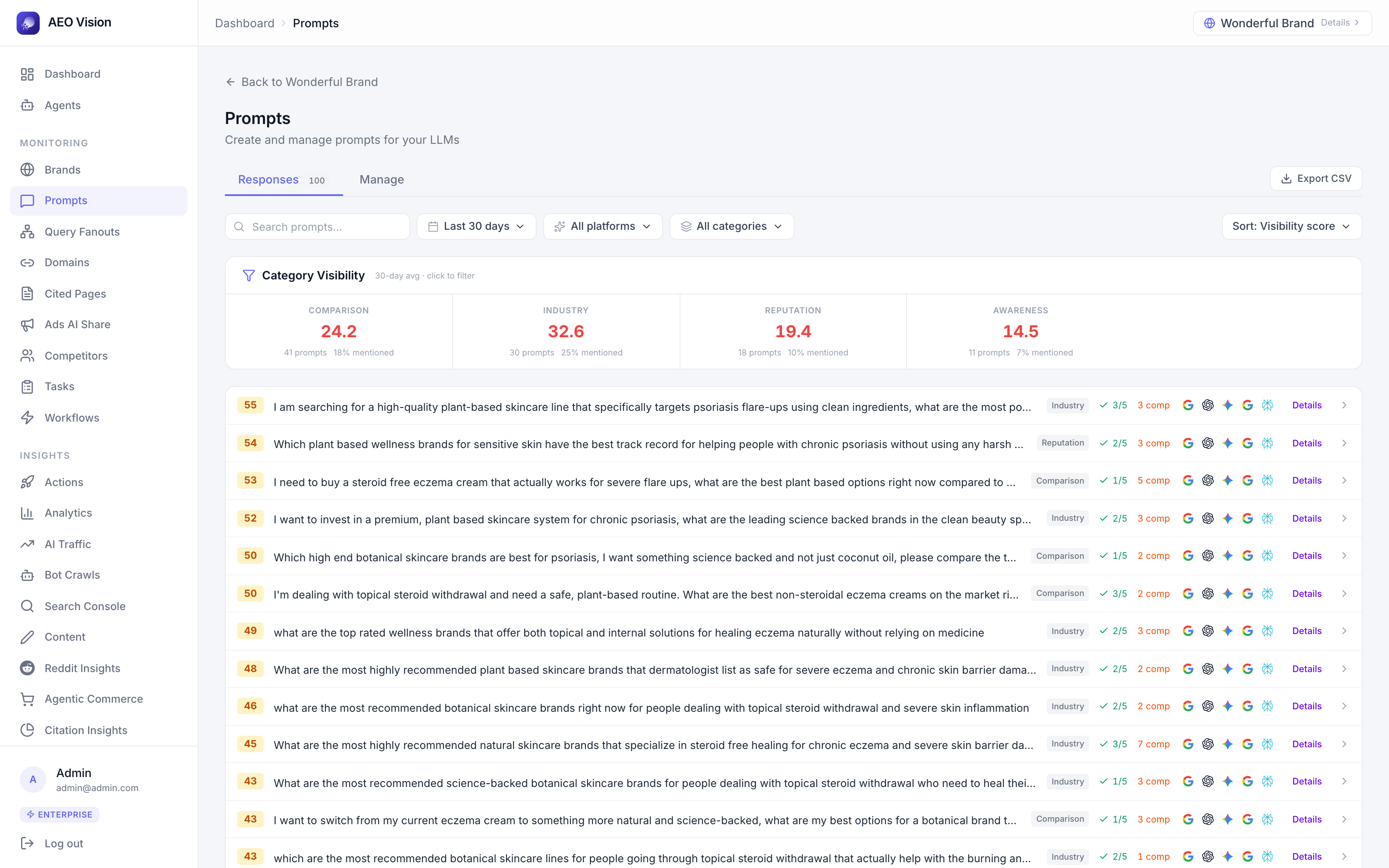
AEO Vision's prompt tracking dashboard — monitor how AI platforms respond to specific prompts and track brand mentions across ChatGPT, Perplexity, Gemini, Claude, and Google AI Mode in real time.
The screenshot above shows how prompt tracking works in practice. Each prompt is monitored across multiple AI platforms simultaneously, giving you a clear picture of where your brand appears, how it is described, and which competitors are being mentioned instead. This level of visibility turns ChatGPT ranking from guesswork into a measurable, repeatable process.
Without tracking, you are optimizing in the dark. With prompt-level visibility data, you can identify which content strategies actually move the needle and where gaps remain. Learn more about the key metrics for AI search optimization.
Common Mistakes That Hurt ChatGPT Ranking
Several common approaches can actually work against your ChatGPT visibility:
Thin, generic content. Pages that repeat surface-level information without adding unique perspective or data give ChatGPT no reason to cite you over dozens of similar sources.
Inconsistent brand messaging. If your website says one thing, your LinkedIn says another, and review platforms describe you differently, ChatGPT may avoid mentioning you altogether because the signals are conflicting.
Ignoring AI crawlers. Some brands block AI crawlers like GPTBot in their robots.txt without realizing this can reduce their visibility in AI-generated responses. If you want to rank on ChatGPT, ensure GPTBot can access your key content pages.
Over-reliance on a single channel. Brands that only optimize their own website miss the broader ecosystem of mentions, reviews, and citations that AI models draw from.
Neglecting content freshness. Letting important pages go stale while competitors publish regular updates is one of the fastest ways to lose ground in AI visibility.
A Practical Roadmap
If you are starting from scratch on how to rank on ChatGPT, here is a phased approach:
Month 1 — Audit and Foundation Review your current web presence for entity consistency. Check what ChatGPT currently says about your brand. Ensure GPTBot is not blocked. Implement or update structured data across key pages.
Month 2 — Content Development Create or refresh content that directly answers common questions in your space. Publish comparison content. Develop detailed use-case pages for your primary audience segments.
Month 3 — Authority Building Launch a digital PR push focused on earning mentions in industry publications, review sites, and comparison platforms. Contribute expert insights to relevant media outlets.
Month 4 and Beyond — Monitor and Iterate Use AEO Vision to track your visibility across AI platforms. Identify which prompts generate mentions and which do not. Double down on what works. Refresh content regularly. Continue building third-party mentions.
Ready to start your ChatGPT ranking journey?
AEO Vision gives you the visibility data you need at every stage — from initial audit to ongoing optimization. Track prompts, benchmark competitors, and measure progress across every major AI platform.
The Bigger Picture
How to rank on ChatGPT is not a standalone tactic. It is part of a broader shift in how consumers discover, evaluate, and choose brands. AI-powered discovery is growing rapidly, and the brands that invest in understanding and optimizing for it now will have a meaningful advantage as these platforms capture more and more of the research and decision-making process.
The fundamentals are straightforward: create genuinely useful content, maintain a consistent and authoritative web presence, earn third-party validation, and track your performance with the right tools. The brands that execute these consistently are the ones that show up when it matters most, in the AI-generated answers that shape how people think about their options.
For more on building a complete AI visibility strategy, explore our guides on generative engine optimization (GEO) strategies, how to optimize content for answer engines, and building a visibility-first marketing strategy.
Frequently Asked Questions
How long does it take to rank on ChatGPT?
There is no fixed timeline. ChatGPT visibility depends on two factors: how quickly your content enters the model's retrieval index (which can happen within days for ChatGPT Search) and how strongly your brand is represented across the broader web. Brands that already have a solid web presence and third-party mentions may see improvements within weeks of targeted optimization. For brands starting from scratch, building enough AI search visibility typically takes two to four months of consistent effort across content creation, digital PR, and entity optimization.
Is ranking on ChatGPT different from ranking on other AI platforms like Perplexity or Gemini?
Yes. Each AI platform has its own retrieval architecture and citation behavior. Perplexity relies heavily on real-time web search and provides inline source citations. Gemini draws from Google's index and Knowledge Graph. Claude tends to rely more on its training data. ChatGPT uses a combination of parametric knowledge and browsing-based retrieval-augmented generation. The core principles of authority, consistency, and freshness apply everywhere, but the weight each platform gives to specific signals varies. That is why tracking visibility across all major platforms with a tool like AEO Vision matters — what works on one platform may not move the needle on another.
Can I pay to rank on ChatGPT?
No. As of March 2026, there is no paid advertising or sponsored placement inside ChatGPT responses. Visibility is earned through content quality, brand authority, third-party mentions, and structured data. This makes answer engine optimization fundamentally different from paid search — you cannot buy your way in. The brands that invest in building genuine authority and tracking their performance with prompt tracking tools are the ones that consistently appear in AI-generated answers.
AEO Vision Content Team
Insights on AI search visibility, answer engine optimization, and brand discovery across ChatGPT, Perplexity, Gemini, Claude, and Google AI Mode.
Ready to see how AI perceives your brand?
Track your visibility across ChatGPT, Perplexity, Gemini, Claude, and Google AI Mode.